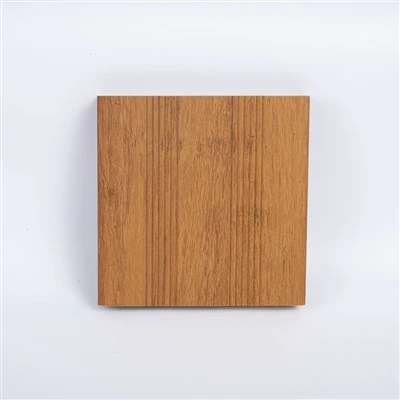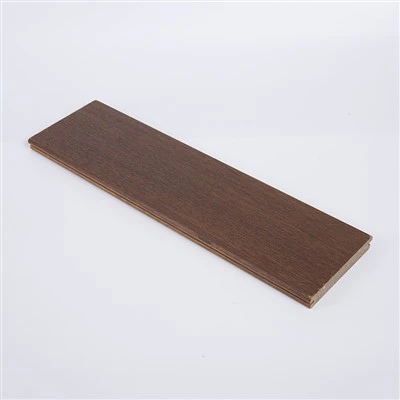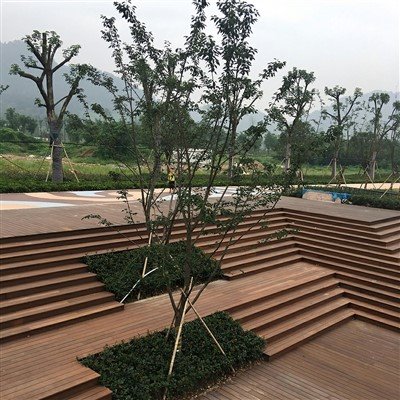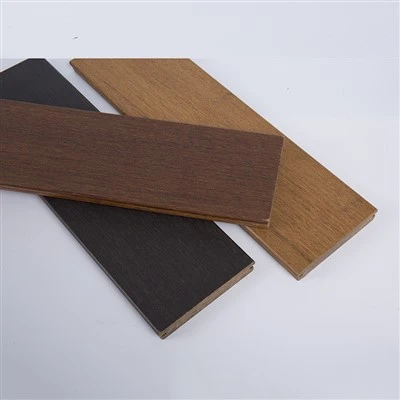

Compared to wood flooring, bamboo flooring comes in simpler styles: some feature long planks with longitudinal grain patterns, while others consist of square tiles arranged in diagonal or parquet patterns. Standard specifications include six sizes-such as 915mm × 91mm × 12mm and 1800mm × 91mm × 12mm-though custom orders are possible within specific ranges (lengths of 46–220cm, widths of 6–15cm, and thicknesses of 9–30mm). Additionally, the surface grain appearance varies depending on the structural design; one can choose between the bamboo's natural face or its cross-section. Bamboo's flexural strength, hardness, and tensile strength are more than double those of wood, and its tensile-flexural strength exceeds that of wood flooring by over 50%. Furthermore, after undergoing nearly twenty processing steps, bamboo flooring matches the functional qualities of wood flooring, offering moderate elasticity, noise reduction, and ease of cleaning.
The inherent tendency of bamboo to curve in a specific direction helps minimize dimensional instability caused by expansion and contraction. There are three primary structural arrangements for bamboo flooring: flat-pressed, vertical-pressed, and T-style. All three methods involve arranging the processed bamboo strips "back-to-back" regarding their curvature; this utilizes the material's natural flexibility to balance expansion and contraction rates across varying environments, resulting in a highly stable structure-with the T-style arrangement being particularly resistant to deformation.
A standout advantage of bamboo flooring is that it stays warm in winter and cool in summer. While bamboo does not inherently generate heat or cold, its low thermal conductivity creates this comfortable temperature profile, allowing people to walk barefoot on it pleasantly in any season-making it an ideal choice for living areas used by the elderly or children. Although modern processing techniques have improved its water resistance, excessively humid environments can still significantly compromise its lifespan (typically around 20 years); consequently, it is not suitable for "wet areas" of the home, such as bathrooms, washrooms, or kitchens.